CAF / major African football
Ayyoub Bouaddi and Morocco: why one young choice says so much about a rising generation
The Lille midfielder’s Morocco decision is becoming a World Cup storyline and a sign of how the Atlas Lions are building for the long term.
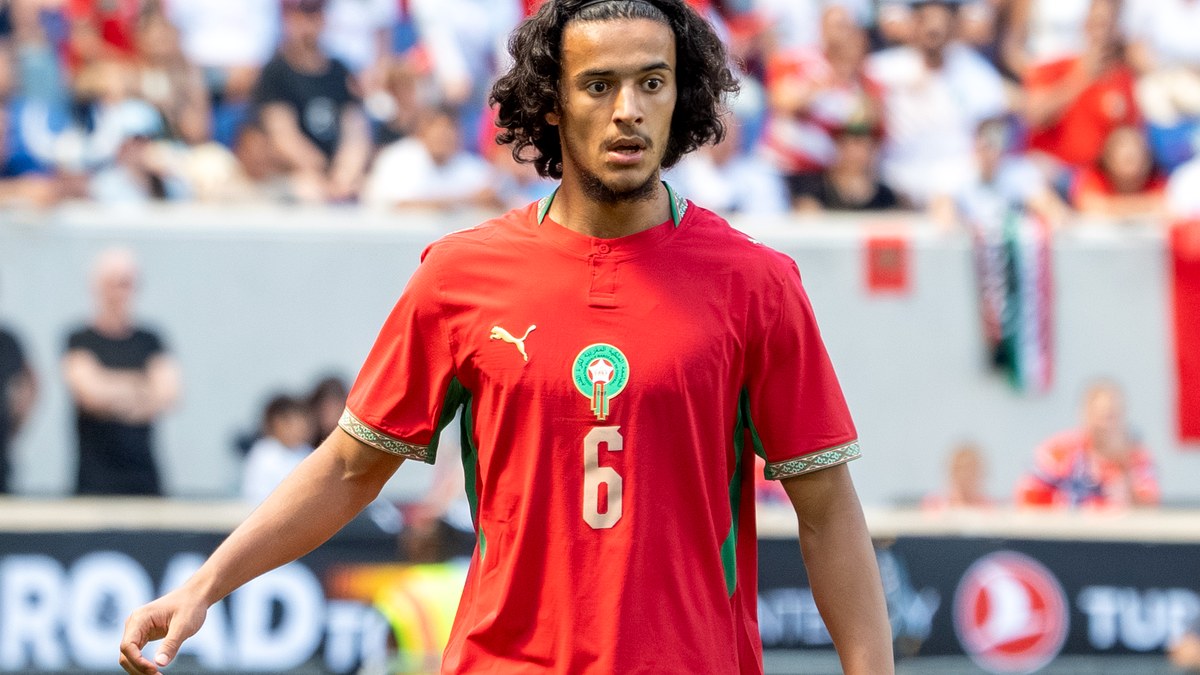
Ayyoub Bouaddi is moving into the wider football spotlight at a moment when Morocco are trying to turn their status into a lasting presence among the major national teams. BBC Sport has profiled the Lille midfielder as a precocious talent, bright in the classroom as well as on the pitch, and above all as a player who chose Morocco after growing up within the French football landscape.
Photo credit: Bryan Berlin / Wikimedia Commons / CC BY-SA 4.0. Real photo of Ayyoub Bouaddi with Morocco, cropped by SokaIQ for editorial publication.
The story is bigger than curiosity around a gifted teenager. It speaks to a modern battle between national teams: spotting dual-national players early, offering them a clear sporting vision and making them feel that an international project has a serious place for them. For Morocco, Bouaddi represents exactly that kind of strategic win. He is not merely another name in an ambitious generation. He symbolises the ability of a federation to convince a player developed in Europe that a major football future can also run through the Atlas Lions.
The timing matters because the World Cup magnifies everything. A composed appearance, a clean passage of play under pressure or a mature cameo can quickly alter how a young midfielder is viewed. In a tournament where narratives form fast, Bouaddi already has a clear one: a very young player, already exposed to high-level club football, carrying market interest in the background, and now attached to a Moroccan side that no longer wants to be treated as a one-tournament surprise.
Choosing Morocco sends a sporting and identity signal
Modern international football is no longer limited to players born and developed inside one national frame. Family journeys, European academies and mixed cultural backgrounds have made national-team choices far more strategic. When a player like Bouaddi chooses Morocco rather than France, the decision speaks on several levels: identity, family, sporting promise and trust in a project.
For a national team, convincing a player of this profile early requires more than symbolic language. There has to be a real route to the pitch. Young talents want to feel they are not being called simply to close an administrative door, but because they fit a football idea. Morocco now have strong arguments: a competitive base, a huge public, global visibility and ambitions that go beyond being an outsider.
That gives Bouaddi's story extra weight. His choice is not best read as a rejection of France, but as an orientation towards a team where his qualities can matter. In a Moroccan midfield already full of personality, he will still have to earn his position. Yet the selection of a technical young player, able to read the game and develop in a demanding club environment, says something about the direction of travel: Morocco want to combine emotional power, tactical discipline and quality on the ball.
Lille is the right school for growth without shortcuts
Lille are an important part of understanding the player. The northern French club have built a strong reputation for developing, improving and showcasing young talent. That is not a neutral environment. A midfielder who earns minutes there learns to receive under pressure, defend inside a collective structure, manage transitions and survive in matches where intensity leaves little room for comfort.
For Bouaddi, that education can be precious. Pure talent attracts attention, but midfield demands a special kind of maturity. A player has to scan before receiving, protect the ball, set the rhythm, cover a team-mate, and know when to slow the game down even when everything around him pushes it faster. Young attackers can sometimes announce themselves through a dribble or a spectacular action. A young central midfielder often has to convince through less visible details: the right angle, the right distance, the right tempo.
That is why his profile is interesting for Morocco. A successful national team cannot live only on transitions or emotion. It needs players who can calm a match, escape pressure and connect the lines. If Bouaddi keeps progressing in that area, he could become a rare resource: a young technical midfielder shaped by European demands and connected to a national team trying to build something durable.
Morocco's generation is operating on a different scale
Morocco no longer move with the same pressure as before. Recent performances have changed the outside view and raised the internal standard. Opponents now prepare for the Atlas Lions with greater respect, and sometimes with greater caution. The challenge is therefore different: it is no longer only about surprising teams, but about confirming status.
In that context, players like Bouaddi help build depth. Major national teams do not rely only on a first eleven. They need competition, options in every position and young players who can enter the group without disturbing the whole structure. A World Cup can drain bodies, create suspensions and force tactical changes. A wider pool becomes essential.
Bouaddi should not be loaded with unrealistic pressure. He does not have to become the centre of Morocco's project immediately. His value is more subtle: he is a future option already present in the present. The staff can watch him, integrate him, give him reference points and see how he responds to international intensity. For a young midfielder, that exposure can accelerate learning if it is handled with patience.
Why major clubs watch this kind of profile
Talk around major clubs often follows any young talent who combines precocity, technical quality and apparent maturity. It has to be treated carefully, because market interest is not a transfer. But it also explains why Bouaddi attracts attention. Clubs are looking for midfielders who can learn quickly, handle pressure and play in more than one register.
European football increasingly values players who can move between functions. A midfielder may be asked to protect the defence, build from deep, press high, appear between the lines or support attacks. The earlier a player understands those variations, the higher his ceiling appears. Bouaddi still has plenty to prove, but his route places him in the category of players followed not only for what they already do, but for what they might become.
The World Cup can amplify that process. Scouts know that an international tournament is not enough to judge a career, but it does reveal reactions: handling noise, adapting to another rhythm and staying clear-headed under global attention. For Bouaddi, every minute can become a valuable sample. The key will be to keep the game simple and clean rather than forcing a personal highlight.
A promising story that still needs time
Bouaddi's story is attractive because it brings together several powerful elements: youth, intelligence, dual culture, a national-team choice, a development club and world-stage exposure. Football, though, demands continuity. The best stories are not confirmed in one week. They are built through full seasons, avoided injuries, coherent career choices and solid responses when expectations rise.
For Morocco, the benefit is already real. The national team are showing that they can attract high-potential players and offer them an ambitious platform. For Lille, the attention once again underlines the value of their development work. For Bouaddi, this moment is an opening: he can enter the international conversation without losing the daily learning that gives a young midfielder his foundation.
The next chapters will show how far he can go. For now, his name deserves attention because it reflects a major trend in contemporary football: strong national teams are built not only by performances on the pitch, but by convincing the right players at the right moment. Ayyoub Bouaddi is one of those cases where the future is already beginning to appear in the present.