World Cup
Infantino defends World Cup hydration breaks as debate grows
The FIFA president says hydration breaks are a sporting measure, but the argument now includes match rhythm, coaching and television perception.
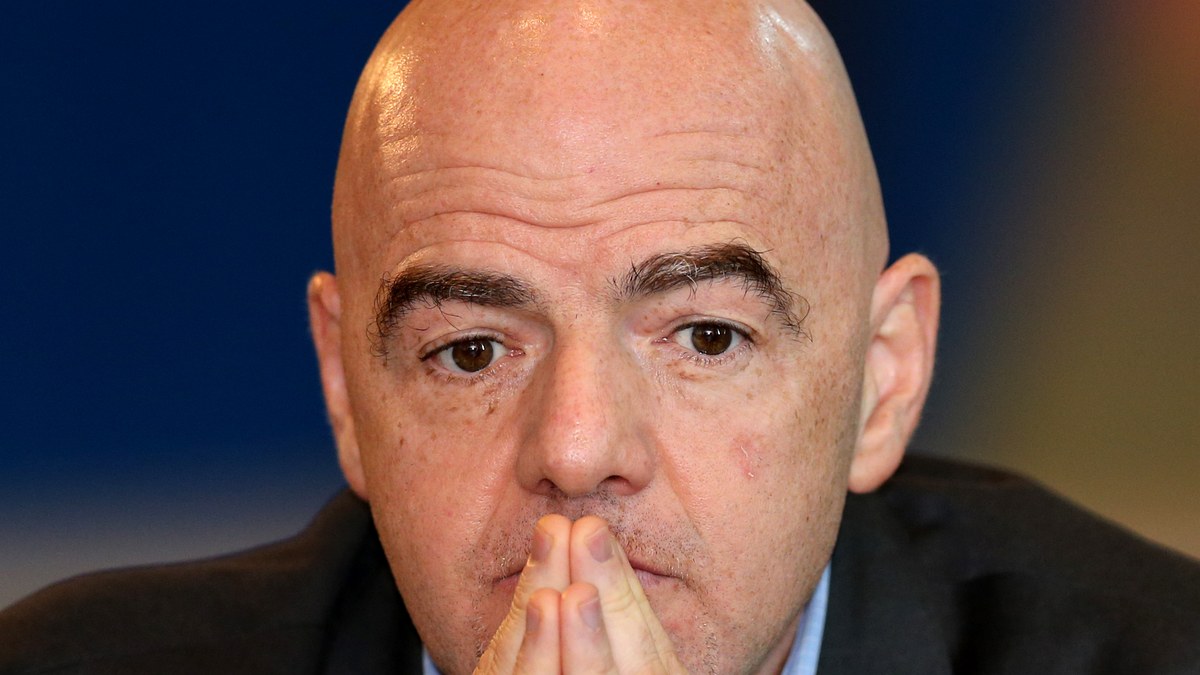
Gianni Infantino has moved to defend World Cup hydration breaks at the point where the debate has grown beyond heat management. The BBC reports that the FIFA president says the pauses bring no additional revenue to the governing body and should be viewed as a sporting matter. The Guardian also placed the comments inside a live tournament day shaped by final group games, coaching reactions and questions about the rhythm of matches.
Photo credit: Doha Stadium Plus Qatar / Vinod Divakaran / Wikimedia Commons / CC BY 2.0. Real Gianni Infantino press-conference photo, cropped by SokaIQ for editorial publication.
The important point is not only the denial. The North American World Cup has introduced a new television and tactical routine: two three-minute stoppages, midway through each half, which players use to recover and coaching staffs can turn into mini time-outs. In a tournament spread across different time zones and very different weather conditions, that decision changes how matches are watched, managed and sometimes challenged.
A welfare measure has become a tournament argument The original justification is straightforward: protect players from heat. The BBC notes that three-minute pauses were introduced to help teams deal with high temperatures in North America. In principle, that argument is difficult to dismiss. Players are already absorbing travel, short turnarounds, different surfaces and the pressure of a world tournament.
But football never receives a new rule in isolation. Once a stoppage becomes compulsory in every match, it creates effects beyond water and cooling. Players breathe, coaches speak, substitutes reset mentally and broadcasters organise a break that did not exist in the traditional grammar of the game.
That wider meaning is why Infantino’s intervention matters. He is not only answering a medical criticism. He is answering a broader suspicion: that football might be creating commercial windows under the cover of physical protection. In a World Cup of this scale, every visible interruption immediately becomes a governance question.
Infantino is leaning on sporting equality According to the BBC, Infantino says there is no additional revenue for FIFA because commercial agreements were signed well in advance. He therefore frames the pauses as a sporting issue rather than a financial one. He also argues that the aim is to guarantee comparable conditions for every team, including when some fixtures are played in hotter conditions than others.
That equality argument is central. If a pause depended only on the temperature, two matches in the same tournament could offer coaches different opportunities to correct their teams during play. One manager would receive an extra coaching moment in heavy heat, while another would have to wait until half-time in a cooler venue. A uniform rule tries to remove that asymmetry.
Still, uniformity does not end the debate. It moves it. The pauses can make sense for welfare and fairness while also changing the identity of a match. A contest that was gathering pace can lose momentum. A team under pressure can breathe again. A defensive block can receive an instruction that breaks an opponent’s spell. The question is therefore not only whether players should be protected. It is what sporting price the game accepts for that protection.
Coaches have gained a real tactical tool The BBC underlines that coaching staffs are allowed to speak to players during the pauses. That is a major detail. In traditional football, the coach shapes the match mostly before kick-off, at half-time, through substitutions and through quick instructions from the touchline. With two structured breaks, he gains two clear windows to correct build-up, adjust pressing or calm a team that has become too open.
Thomas Tuchel has already said, according to the BBC, that the breaks change the character of a match more than he expected. That matters because it comes from a coach used to tactical detail. A short stoppage can be enough to redefine a marking job, highlight a weak zone or prepare a shift in tempo. In a tournament of small margins, three minutes can carry more weight than a long post-match explanation.
Players also gain a mental advantage. When a team is suffering, it can break the spiral without making a tactical foul or simply clearing the ball. When a team is in control, it has to learn how to restart at the same speed after the pause. The best national sides will be those that treat the stoppages not only as rest, but as a phase to master.
Television remains central to the perception Infantino can say FIFA is not receiving additional revenue; public perception is more complicated. The BBC notes that broadcasters in several countries have shown adverts during hydration breaks, even though that is not happening in the UK. For viewers, the commercial logic can therefore look visible whether the money flows directly to the governing body or not.
That is where modern football runs into its own scale. A stoppage designed for players becomes a broadcast space. A welfare gesture becomes a sequence discussed in stadiums, studios and social feeds. The contractual reality may be accurate, but it is not always enough to convince a public watching the screen fill with commercial messages while the ball is out of play.
FIFA now has to manage two layers of trust. The first is medical and sporting: players must feel the measure genuinely helps them. The second is narrative: supporters must understand why the pause exists, why it is systematic and why it does not distort the tournament. Without clear explanation, every stoppage risks being interpreted through the mood of the match.
A new ritual the World Cup must learn to use The most likely outcome is that the pauses quickly become a tournament ritual. The first matchdays create surprise, then teams adapt. Analysts will soon look at who uses the breaks best, who loses rhythm and which coach turns the moment into a strategic advantage. As often happens, a contested rule may produce a new skill.
The argument should not be simplified. Player welfare matters, especially in a longer World Cup played in demanding conditions. Competitive equality matters too. But the rhythm of football matters, the crowd’s feeling matters, and the boundary between protection and commercial spectacle has to remain readable. Infantino has delivered the official line. The rest of the tournament will show whether players, coaches and supporters come to accept it.
For FIFA, the issue is now practical. These pauses must be explained, consistent and genuinely useful. If they protect players without smothering the game, they will survive the media noise. If they appear to serve the screen and the advertising market first, every stoppage will become another reminder of the mistrust already surrounding global football.