World football
Iran’s US entry change turns World Cup logistics into a sporting issue
The United States will allow Iran to arrive earlier in Seattle before facing Egypt, a World Cup adjustment that puts logistics and competitive fairness back in focus.
The United States Department of Homeland Security has eased Iran’s entry conditions before the national team’s final World Cup group match. BBC Sport reported on Tuesday that Iran will be allowed to travel to Seattle two days before facing Egypt, rather than operating inside the shorter window imposed around their first two matches in the United States. The Guardian reported the same change and noted that Team Melli had planned to lodge an official complaint with FIFA over the travel restrictions.
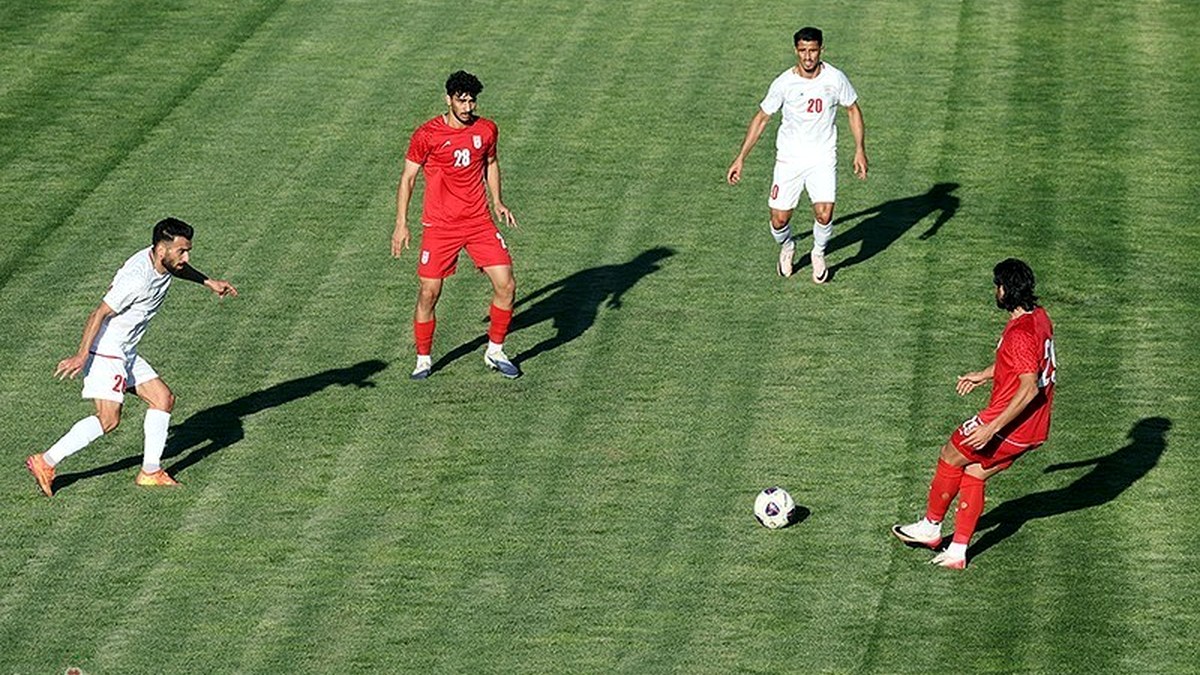
Photo credit: Tasnim News Agency / Wikimedia Commons / CC BY 4.0. Real 2026 image from an intra-team friendly match of the Iranian national football team, cropped by SokaIQ for editorial publication.
The story is sporting before it is diplomatic because it touches the preparation of a team still fighting through a tight group stage. Major tournaments are built on recovery, training rhythm, tactical detail and stable logistics. When one national team has to enter a host city later than its opponents and leave immediately after playing, the restriction is not only administrative. It affects sleep, treatment, travel timing, video work and the sense of competitive fairness around the tournament.
A concession that changes Seattle preparation The adjustment gives Iran an extra day compared with the framework used for their earlier American fixtures. BBC Sport quoted the Department of Homeland Security saying that, for the Seattle match, the team would be permitted to arrive two days before kick-off while still being required to leave on the day the match ends. The Guardian reported that the American authorities framed the change as compatible with the tournament’s security protocols.
At a World Cup, an extra day is not a small detail. It allows a less abrupt arrival, a more realistic activation session and a better adjustment to the match city. It also gives medical and physical staff more time to manage recovery. For a team still playing for its place in the next round, that additional window can improve the quality of preparation without guaranteeing anything on the pitch.
The decision does not remove every restriction. Iran remains inside a special travel framework and still has to depart after the fixture. But it answers part of the complaint raised by the federation and the coaching staff: the difference in treatment should not become a factor capable of tilting the football itself.
Football caught between security and sporting fairness The sensitive point is the balance between two obligations. On one side, the host country is responsible for stadium security, base camps, team movements and the wider match environment. On the other, FIFA has to protect the principle that every team competes under comparable conditions. When those two responsibilities collide, the line becomes difficult to manage.
Head coach Amir Ghalenoei had criticised the situation around his squad. BBC Sport reported that he felt his team had been deprived of preparation time and that the restrictions were not suitable for a World Cup. That kind of statement is more than pre-match rhetoric. It raises a broader question: when does an organisational measure become a competitive disadvantage?
The American response tries to cool that debate without abandoning the security framework. By opening a longer window for Seattle, the authorities show that an adjustment was possible. FIFA now has to ensure that the decision does not look like a one-off gesture, but part of a clear approach for any team facing unusual constraints during the tournament.
A group-stage race shaped by logistics Iran’s tournament base makes the issue more visible. The squad is operating out of Mexico during the competition and has to move into American host cities for selected matches. The Guardian noted that the travel pattern and rapid returns have complicated recovery, especially when the next fixture carries qualification consequences. Preparation is not just a training session. It includes transport, food, treatment, stress management and staff organisation.
That is why the Seattle trip mattered. The journey is more demanding than the earlier movements around Los Angeles and Tijuana, and it requires a heavier operational plan. This is the point on which the American authorities accepted a change. Modern football is often decided in margins that do not appear in highlight clips: a night of sleep, a fuller session, a more controlled arrival time.
For Iran, the concession may also carry psychological value. It does not remove the pressure of the match, but it tells the squad that its complaint was heard. In a tense tournament environment, that signal can help the staff pull the conversation back toward football rather than external obstacles.
A governance test for the 2026 World Cup The episode is a reminder that the 2026 edition is a vast World Cup staged across three countries, with long travel and political contexts that can be heavy. The tournament’s promise is openness, scale and diversity. But that ambition also forces organisers to solve very practical problems: visas, borders, security, transport, training bases and coordination between national authorities.
FIFA cannot simply celebrate the size of the competition. It also has to make sure that the size does not create situations in which some teams feel trapped inside a different administrative machine. Federations accept the demands of a global event, but they expect those demands to be proportionate, explained and applied in a way that makes sporting sense.
The American decision around Iran can therefore be read as an operational correction. It does not solve every tension between football and politics, but it shows that the schedule can move when a problem becomes too visible. For organisers, the next challenge is to handle similar cases before they become public controversies.
The pitch has to become the centre again The best outcome for the competition is that the relaxed entry window allows the match to be approached in a more normal football atmosphere. Iran will still have restrictions. Egypt will still have its own sporting context. Supporters will still have their expectations. But the main discussion should return to qualification, team form and coaching choices.
A World Cup struggles with the idea of administrative advantage. It accepts differences in style, budget, experience and talent. It is less comfortable with a team arguing that its travel calendar has been built against it. By granting an earlier arrival in Seattle, the American authorities reduce that risk.
For Team Melli, the message is clear: the preparation space has opened slightly, but the sporting responsibility remains. For FIFA, the warning is just as clear. In a tournament this large, logistics are not a secondary topic. They are part of the credibility of the competition itself.