FIFA / world football
World Cup severe heat: Miami and Monterrey reopen the player welfare debate
Two matches played in heavy heat put player health, kick-off planning and match rhythm back at the centre of the World Cup conversation.
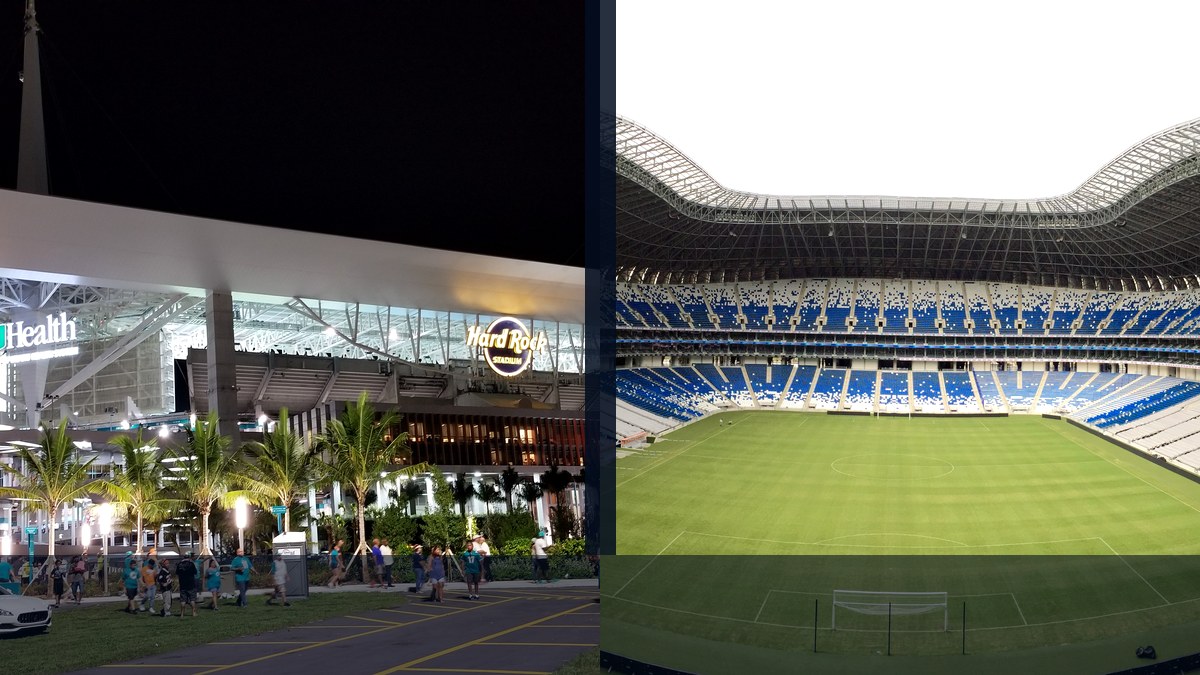
The Guardian published an analysis on Friday saying that two World Cup matches were played in conditions described as severe heat, with Miami and Monterrey placed at the centre of the debate. This is not just a weather note around a major tournament. It is a question about how international football protects players, sets kick-off times and explains decisions when heat becomes both a sporting factor and a medical concern.
Photo credit: A.J. Lipp via Wikimedia Commons / CC BY-SA 4.0; Rick González via Wikimedia Commons / Flickr / CC BY 2.0. Real photos of Hard Rock Stadium in Miami Gardens and Estadio BBVA in Monterrey, cropped and combined by SokaIQ for editorial publication.
The most important point is the nature of the signal. Heat does not merely create discomfort. It changes rhythm, recovery, technical clarity and the capacity of teams to press for long spells. In a global competition, where margins can turn on freshness and concentration, climate becomes a performance variable. Hydration breaks help, but they do not answer the whole question when temperature, humidity and prolonged exposure combine.
FIFPRO, the global players' union, has documented the impact of extreme heat on player health and performance for several years. Its scientific work with partners underlines that football has to measure risk before kick-off, not only react when players show fatigue. For the World Cup, this debate will be watched closely because the tournament crosses several climate zones, television windows and stadium formats.
Heat becomes an invisible opponent
A match played in heavy heat does not always look like a dramatic emergency. Sometimes the signal is quieter: runs become shorter, pressing is less synchronised, transitions become more cautious and players take a few extra seconds to recover their positions. The crowd sees a drop in intensity; coaching staffs see a build-up of risk.
That is how heat acts as an invisible opponent. It does not wear a shirt, but it imposes its tempo. A team that wants to press high has to calculate its effort. A full-back asked to repeat runs must choose the right moments. A midfielder covering large spaces can lose precision in later phases. Goalkeepers and centre-backs, even if they sprint less often, are still affected because clear distribution and communication depend on the overall fatigue of the team.
The debate is therefore not an excuse for teams. It is a real reading of the game. In a tournament where staffs constantly talk about details, heat is a massive detail: it alters tactics, substitution plans and sometimes the ambition of the initial match strategy.
Hydration breaks are useful but incomplete
Hydration breaks have a clear purpose. They give players time to drink, breathe, receive instructions and briefly reduce physical stress. But they do not change air temperature, humidity or the total duration of exposure. They also do not replace a wider discussion about kick-off times, shade, stadium design and the ability of players to recover between matches.
The risk for organisers would be to present the break as a complete answer. It is better understood as one tool in a wider kit. Football can also adapt certain kick-off slots, strengthen medical monitoring, clarify decision thresholds, inform teams more openly and accept that the spectacle is sometimes improved by being protected rather than forced.
For coaches, this becomes practical. Substitutions are not only about changing an attacking pattern. They can preserve a pressing line, protect a player who has repeated too many runs or prevent fatigue from opening dangerous spaces. A team prepared for heat can look calmer, not because it plays less, but because it chooses its efforts better.
The global calendar forces football to plan ahead
The modern World Cup is a sporting, media and logistical machine. It has to consider broadcasters, supporters, travel, stadiums and teams. But the number of host cities and the variety of climates demand sharper planning. The same competition can move from a relatively comfortable evening to heavy heat that changes physical reference points.
This is not a new reality, but it is more visible because players, unions and staffs speak more openly about health. The issue is not to remove difficulty from football. Major tournaments have always required adaptation and character. The question is where the line sits between normal difficulty and avoidable risk.
It is also a sporting fairness issue. If a team plays in very heavy conditions and then has to recover quickly, the next match can be affected. Heat does not end at the final whistle. It leaves traces in recovery, sleep, muscle preparation and the ability to repeat efforts a few days later.
Players have to remain at the centre
Football often speaks about spectacle, calendars and revenue. In this issue, the player has to remain the priority. Without players capable of producing their best level, the spectacle damages itself. Protecting health is not opposed to sporting or commercial interests; it is a condition for the tournament to keep its quality.
Players' unions matter because they carry a voice that is not tied only to one result. Coaches can warn, doctors can measure and organisers can adapt, but the collective voice of players gives continuity to the debate. It reminds football that performance is not infinite and that modern preparation has to include climate just as it includes travel, training load and recovery.
This discussion should not wait for a serious incident before moving forward. The best scenario is one where thresholds are clear, decisions are planned and teams know what to expect. A global tournament cannot control the weather, but it can control the quality of its response.
A sporting issue as much as a medical one
Severe heat is sometimes treated as a medical question separate from the pitch. In reality, it connects both. It affects health, but also tactics, rhythm, squad depth, recovery and competitive fairness. The best staffs understand it already: managing heat is managing the match.
For the World Cup, this analysis arrives at the right time. It does not mean every match exposed to heat becomes unplayable. It means football has to take the signals seriously, without minimising the players' experience or turning every warning into a culture-war argument. Miami and Monterrey are reminders that, in a global tournament, the environment is part of the game.
What comes next depends on transparent decisions. If heat thresholds are explained, if breaks are consistent, if kick-off times are discussed alongside medical data and if players feel their safety genuinely matters, the debate can become constructive. If not, every match played in heavy conditions will reopen the same question: is football doing enough to protect the people who make the spectacle possible?