Women’s football
Felicia Schröder joins Real Madrid as women’s football enters a new phase
Real Madrid have officially signed Felicia Schröder until 2030 in a deal Häcken describe as the most expensive in women’s football.
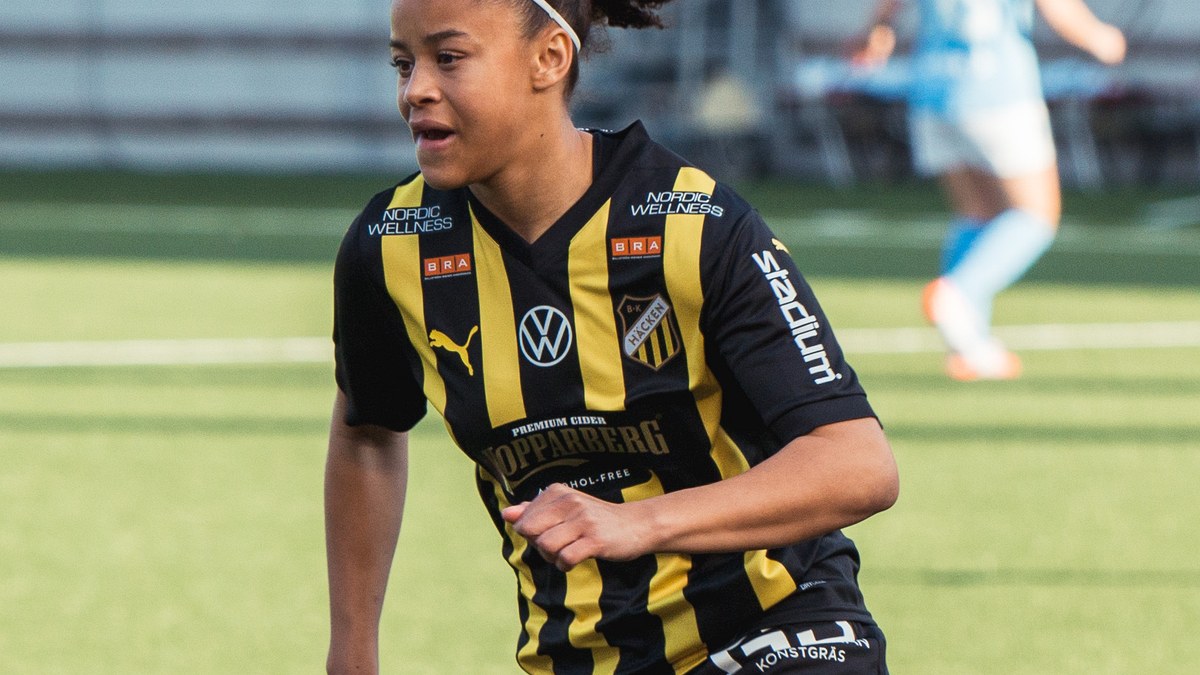
Real Madrid have confirmed the signing of Felicia Schröder, a nineteen-year-old Sweden international forward, in a move that sends a strong signal about the club’s ambition in women’s football. Madrid’s official statement confirms an agreement with BK Häcken and a contract running until June 30, 2030. BBC Sport reports that her former club describes the transfer as the most expensive in the history of women’s football, while also noting that the exact transfer figure has not been made public. The story is therefore firm enough to treat as a major transfer landscape event: an official signing by a global club, a confirmed contract length and a financial reading supported by a reliable source.
Photo credit: Axel Andersson / Wikimedia Commons / CC BY 4.0. Real Felicia Schröder image with BK Häcken in the Damallsvenskan, cropped by SokaIQ for editorial publication.
This is not only the story of a young goalscorer changing leagues. It captures the acceleration of a transfer landscape in which Europe’s biggest clubs are trying to secure elite profiles earlier than before. Schröder arrives with heavy production in Sweden, a reputation as an early finisher and an international profile already bigger than her age. For Real Madrid, the objective is clear: reduce the gap to Barcelona in Liga F, become more forceful in Europe and build an attack that can last for several seasons.
An official signing, not transfer noise The first difference from many transfer landscape stories is the clarity of the source. Real Madrid have not merely allowed interest or advanced negotiations to circulate. The club published a formal announcement confirming the agreement with BK Häcken, Schröder’s arrival and the length of the contract. In a period when major women’s transfers are still sometimes less fully documented than equivalent men’s moves, that official confirmation gives the story a solid base.
BBC Sport adds the important economic layer. According to the British outlet, Häcken describe the deal as the most expensive transfer ever in women’s football. The Swedish club have not publicly detailed the exact figure, but the comparison with the previous record immediately places the move in another category. This is not a routine squad addition. It is a project investment.
Real Madrid are sending two messages at once. The first is sporting: the club want players who are already productive, not only prospects to be developed slowly. The second is institutional: the women’s team is entering a phase in which buying elite talent becomes an accepted way to accelerate. In a transfer landscape that is professionalising quickly, this kind of signing can change how other leading players see Madrid.
Why Felicia Schröder has drawn this level of attention Schröder has built her importance unusually quickly. At BK Häcken she scored heavily, gained responsibility and showed she could affect matches that mattered. Real Madrid’s announcement underlines her status as a Sweden international and points to her recent impact in the Women’s Europa Cup, where her finishing made her one of the central figures of the competition. Even without turning every statistic into a guarantee, the profile is clear: young, decisive and mature enough to attempt a more exposed step.
At nineteen, there is always risk. Changing league, language, media environment and competitive rhythm can slow a player down. Liga F offers different spaces, defenders more used to elite forwards and a context in which every Real Madrid match is judged through the rivalry with Barcelona. Schröder will not simply reproduce her Swedish output by force of habit.
That is exactly why the move is interesting. Madrid are not buying a player at the end of her peak; they are buying a trajectory. If the adaptation is handled well, the club can benefit from her best years rather than paying only for what she has already done. That logic is becoming more visible across European women’s football: clubs that want to dominate tomorrow are moving before the transfer landscape becomes even more expensive.
Real Madrid are chasing a genuine competitive jump Last season again showed Madrid’s central challenge: being strong while still chasing a benchmark as established as Barcelona. Finishing high in the table is not enough when the Catalan club sets the technical, collective and European standard. Real therefore need to build a sharper identity, with more depth and more attacking power. Schröder’s arrival fits that requirement.
A modern women’s team is not built only with famous names. It needs creation, speed, finishing, pressing and variety. Schröder can add a direct penalty-box threat, but also a type of energy that forces defenders to protect deeper spaces. If she integrates quickly, she can create room for the players around her and give Madrid a more vertical solution in closed matches.
The club must still avoid loading too much weight on her shoulders. A record transfer, or a deal presented as one, creates immediate expectation, but the development of a young forward is also measured through movement, connections, repeated runs and growth without the ball. The best scenario for Madrid would be to surround her well enough that the transfer figure does not become the only story attached to her.
A women’s transfer landscape moving into a new phase The Schröder deal confirms a wider trend: women’s football is entering a stage where transfer transfer figures are becoming strategic markers. Major clubs no longer want only to wait for contracts to expire or rely on local development. They are paying to save time, secure rare profiles and show players that their projects are serious.
That evolution is healthy if it comes with a stronger framework: better contracts, better player protection, stronger medical structures, deeper staff and a sensible calendar. The danger would be copying only the pressure of the men’s game without importing the safeguards that allow players to develop sustainably. A more expensive transfer landscape also has to become a more responsible one.
For selling clubs such as Häcken, the picture is mixed. Losing a major player weakens the immediate sporting level, but a significant sale can fund the academy, recruitment and the wider women’s project. Schröder’s move may therefore become a reference point for other development clubs: producing elite women’s talent can now create real economic importance.
What the move can change for Madrid In the short term, Real Madrid gain a powerful story and a highly watched attacking option. Supporters will expect goals, media coverage will revisit the reported scale of the transfer, and Schröder will need to learn quickly without losing what made her special. In the medium term, the question is deeper: if Madrid turn this signing into collective progress, they can reduce part of the gap to Europe’s best sides.
The environment will matter most. A young striker needs minutes, reference points, confidence and pressure applied in the right dose. She has to transfer figurel that the club believes in her without asking her to solve every attacking issue alone. If that line is respected, Real Madrid are not simply signing a goalscorer; they are installing a piece around which an attack can evolve.
Schröder therefore arrives in Madrid with a double status: huge promise and a symbol of a growing transfer landscape. The signing is official, the sourcing is strong and European women’s football has received another signal. The next weeks will show how she adapts. For now, her transfer gives Real Madrid a more visible ambition and gives the women’s game a new benchmark.