FIFA / world football
United States beat Australia and move into the World Cup knockouts
The United States secured their place in the World Cup knockout phase after a controlled win over Australia in Seattle.
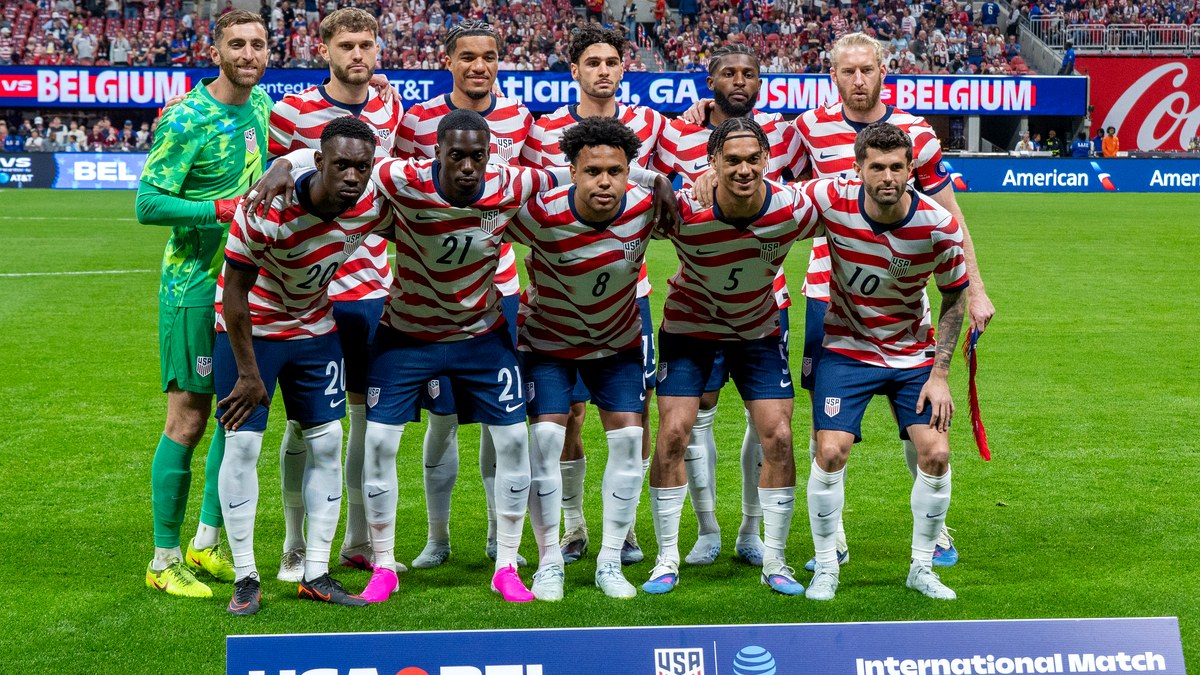
The United States took a major step in their home World Cup by beating Australia in Seattle and securing a place in the knockout phase. Sky Sports confirmed that Mauricio Pochettino’s side have become the second team through after Mexico, while The Guardian described a night in which the hosts sent a message built more on control and resilience than noise alone.
Photo credit: Bryan Berlin / Wikimedia Commons / CC BY-SA 4.0. Real United States men’s national team photo, cropped by SokaIQ for editorial publication.
The qualification does not answer every question around this team, but it changes the tone of the American tournament. Before kick-off, the pressure around the United States was about more than results. A co-host had to show that it could carry the event on the pitch, not only in the stadiums and broadcast packages. After coming through a disciplined, physical Australian test, the group can now look forward with more control and less urgency.
The timing matters too. Qualifying before the final group match gives the staff breathing space, protects key players and allows rotation decisions to be made without every minute feeling like a crisis. In an expanded World Cup, reaching the next stage is the first duty. For the United States, it is now a platform, not a promise.
Qualification lifts pressure from the hosts
A host nation always lives a different tournament. Every match becomes a national referendum, every mistake feels larger, and every positive result can create an energy that is hard to reproduce elsewhere. The United States have been carrying that double pressure: to compete as a football team and to give their own World Cup a sporting heartbeat.
This win over Australia removes some of that noise. The question is no longer simply whether the Americans will survive their group. It becomes how far they can push their intensity, their depth and their ability to manage tighter matches. The place in the knockout phase lets the squad breathe, but it also raises expectations.
Pochettino can treat it as a form of validation. His team do not need to be spectacular every night to move through a tournament. They need to be compact, secure in key moments, aggressive in useful areas and ready to exploit momentum swings. The Seattle match looked like that kind of tournament win: not a constant demonstration, but a result built on patience, efficiency and emotional control.
Alex Freeman gives the depth chart a new face
Alex Freeman naturally stands out from the night, with Sky Sports highlighting his goal in the American win. Contributions like that are valuable in a tournament where attention often sits on the established leaders. When a less expected player shapes a qualification match, it widens the list of solutions and forces future opponents to look beyond the most familiar names.
For Pochettino, that matters. Knockout football demands more than a preferred starting side. It needs substitutes who are ready, profiles that fit specific scenarios and players unafraid to take responsibility in a heavy atmosphere. A team that depends only on two or three stars becomes easier to read. A team that spreads decisive moments across the squad becomes more difficult to contain.
The symbolism is strong for the American public as well. Successful campaigns are built on images that create attachment: a younger player emerging, a collective celebration, a stadium realising that the team is genuinely moving forward. Freeman’s moment can become part of that if it leads to a larger role, or simply if it reminds everyone that the bench and the next layer of the squad already matter in this run.
Australia made the test useful
Australia are not a soft opponent. The Socceroos usually bring density, contact, discipline and a real ability to make matches uncomfortable. For an American team lifted by the context of hosting, that kind of opposition is useful. It forces seriousness, demands duels and prevents the hosts from confusing atmosphere with control.
That is why the result has value. The United States did not merely ride the noise in Seattle. They came through a match in which the opponent could slow the rhythm, close wide channels and force quick decisions. In a tournament, the most instructive wins are not always the smoothest. Sometimes they are the ones that prove a side can win even when the game is not fully open.
Australia, meanwhile, are left with less margin. Losing to a qualified co-host does not necessarily close every door, but it narrows the route. The Socceroos will need to recover physically and mentally because matches like this often leave a mark. You can compete, have spells and still be reminded that one or two decisive moments against a confident host can reshape the group.
What it changes for Pochettino
Early qualification gives Pochettino one of the most important tools in tournament football: choice. He can protect certain players, test a partnership, keep the main spine in rhythm or begin preparing a more specific plan for the next round. That kind of freedom is rare in a group stage, especially for a team carrying this level of national attention.
The danger is turning comfort into drift. The best teams use early qualification to sharpen their habits, not to slow down. The United States still need to refine their attacking structure, their management of weaker spells and their ability to turn pressure into clear chances. The next stage gives them time, but it does not automatically give them maturity.
Pochettino therefore has to balance two targets. On one side, he must preserve the energy of a squad that wants to go deep. On the other, he has to keep the intensity high enough to maintain the tournament rhythm. That is often where host nations are tested properly: after the first release of joy, can they stay cold, methodical and demanding.
A signal to the rest of the bracket
The United States do not suddenly become favourites because they have qualified. But they do become a team that nobody can treat as background scenery. The crowd is behind them, the place in the next phase is secured, and the coaching staff now have tactical margin to prepare what comes next.
That combination can be powerful. In international tournaments, momentum can matter almost as much as theoretical ranking. A team that wins early, avoids panic and builds a strong relationship with its public can become harder to remove than expected. The American challenge is to turn that energy into repeatable performance.
The next test is mental. The hosts have shown that they can clear the Australian hurdle and reach the knockout phase. Now they have to show that they can play with the status of a team people expect to advance further. That is a different pressure, quieter than the first one, but often more revealing.