Football business
WSL Fan Choice: why drinking in stands changes matchday
WSL and WSL2 clubs can allow drinking in view of the pitch after a positive trial. The decision touches safety, revenue and the identity of English women’s football.
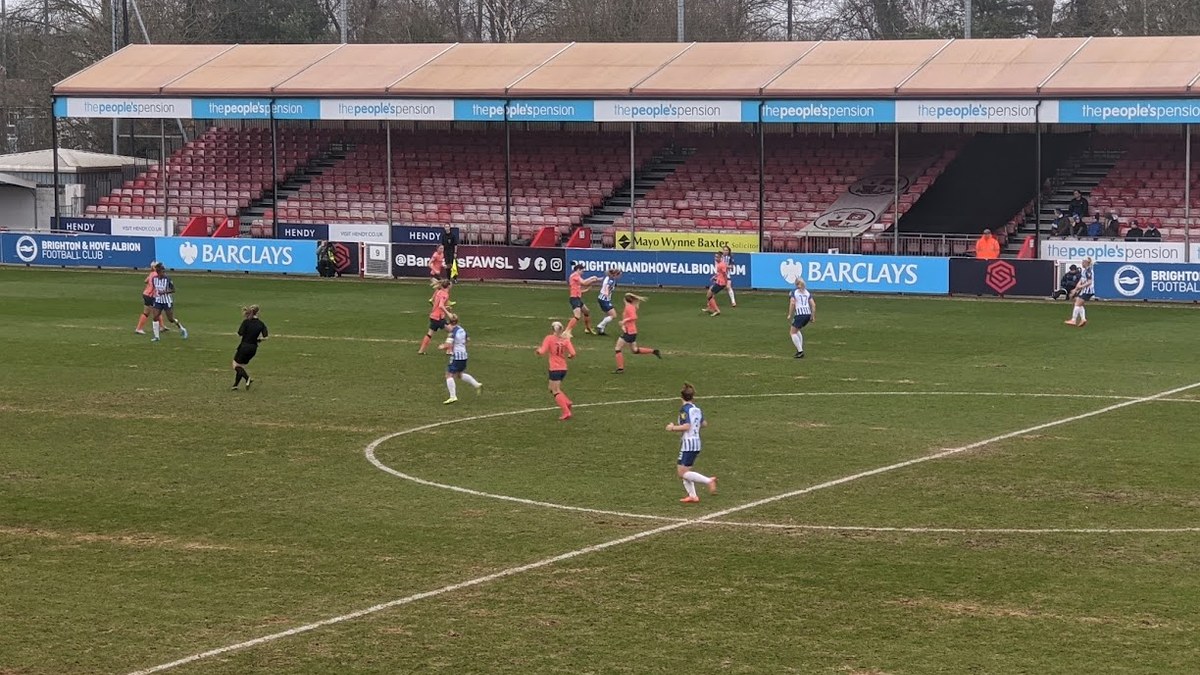
English women's football has opened a debate that goes beyond the simple sale of drinks inside a stadium. On Monday 22 June 2026, The Guardian reported that WSL and WSL2 clubs will be able to allow supporters to drink alcohol in view of the pitch from next season, after a trial period considered successful. The change does not force every club to adopt the policy, but it alters the framework around a matchday experience that had already been watched closely by clubs, supporters and league officials.
Photo credit: Wikimedia Commons / CC0. Real Women's Super League match photo at Broadfield Stadium, cropped by SokaIQ for editorial publication.
The background matters. WSL Football had already explained that the Fan Choice programme was being expanded to fourteen clubs across the two divisions for the 2025/26 season, with a safety record that gave the league confidence. The official update pointed to strong support from surveyed fans, no reported safety incidents inside the evaluated framework and a willingness to test a more flexible approach than the one applied in English men's football. The move reported today therefore fits a clear trajectory: the league is not stepping into the unknown, it is extending an experiment that produced enough evidence to influence regulation.
The issue is not only about alcohol. It is about how professional women's football wants to shape its own matchday identity, rather than automatically copying the restrictions, habits or fears of the men's game. In a growing WSL, where clubs are trying to fill larger stadiums, retain family audiences and increase event-day revenue, every detail of the experience matters. Fan Choice becomes a test of commercial maturity as much as a test of trust in supporters.
A decision that separates the WSL from the men's framework English men's football remains shaped by a strict legal framework around drinking alcohol in view of the pitch. The WSL operates in a different environment, and that is exactly why this decision is significant. It does not dismiss safety concerns. It starts from the idea that women's football can assess its own crowds, behaviours and risks instead of inheriting a rule designed for another historical context.
That distinction gives the WSL a rare space to experiment. Clubs are not obliged to open the stands to drinking. They can choose according to their stadium, audience, security operation and commercial strategy. That flexibility reduces the risk of a uniform policy being applied badly. It also allows the league to observe different models: major Premier League grounds used by women's teams, smaller home venues, regular local audiences, high-demand fixtures and quieter league matches.
The key word is choice. Choice for clubs, choice for supporters, and choice for the league to learn from real evidence. If the policy works, it can become part of a positive matchday identity. If it creates tensions, it can be adjusted or withdrawn. Either way, the WSL gains a more detailed understanding of its audience, which matters in a period when the competition is balancing fast growth with a sustainable stadium culture.
Fan Choice becomes a commercial laboratory For clubs, the measure also has an obvious economic dimension. Matchday is no longer limited to the minutes on the pitch. It includes arrival at the ground, food and drink points, family areas, routines with friends, merchandise, travel and the time supporters spend inside the venue. Allowing controlled drinking in the stands can raise food and drink revenue, but it can also smooth the experience for fans who do not want to choose between following the match and leaving their seat.
WSL Football said in its expansion update that earlier evaluations found many supporters felt the overall experience improved, while food and drink spend also increased across the fixtures involved. That is not a minor detail. Professional women's football is still building its revenue models, and matchdays remain a direct lever to help clubs fund operations, improve services and make the event more attractive.
The order of priorities still has to be right. A league cannot trade safety for a few extra sales. But if internal evidence, club feedback and fan behaviour show that the framework is manageable, the WSL can turn a restriction into a competitive advantage. The policy becomes a sign that the competition sees itself as a complete sporting product, with a different, more flexible and potentially more welcoming experience.
Safety remains the real credibility test Safety remains the sensitive point. A successful trial does not automatically guarantee success when the policy is applied more widely. Fixtures are not all the same. A derby, a high-tension match, a game in a major stadium or a large away following can create different dynamics. Clubs will therefore have to treat this permission as an operational policy, not as a simple commercial line.
That means clear rules, informed stewards, visible communication, sales limits where needed and coordination with local authorities. Supporters must understand what is allowed, where, when and under which conditions. Clubs will also have to monitor weak signals: queues, isolated behaviour, family complaints, more sensitive areas of the ground, and differences between ordinary league matches and major occasions.
If the WSL wants to protect its growth, it must preserve what has already become one of its strengths: an atmosphere often seen as more accessible, more family-friendly and less intimidating than some men's environments. Fan Choice should not weaken that advantage. It has to show that a freer experience can remain responsible. That is where the decision will be judged, much more than in statements or broad arguments.
A modern image for English women's football The shift arrives at a time when English women's football is trying to consolidate its place among the world's most attractive leagues. Stadiums are growing, audiences are rising, players are becoming stronger public figures and clubs are investing more in their structures. In that context, crowd experience is not a side issue. It shapes the image of a modern competition that can listen to supporters and evolve its habits.
The WSL's choice may also influence other competitions. If the policy runs without major incident, it will give arguments to those who believe different football environments should be assessed on their own evidence rather than treated as the same risk. If a visible problem appears, critics will use it to demand a retreat. The league is therefore walking a narrow line: it wants to innovate, but it knows that innovation in the stands is watched carefully.
The symbolic dimension is strong. Allowing clubs to decide recognises that women's football is no longer just an extension of the men's game. It has its own audiences, its own data and its own growth levers. That autonomy may be the most important part of the announcement.
What next season must prove Next season will show whether this opening becomes a genuine stadium-management reference point or simply an extended experiment. Clubs that adopt the policy will need to produce serious feedback, listen to supporters and adjust practical details quickly. The WSL, meanwhile, will have to protect the overall coherence of the competition: offering freedom without making each venue feel detached from a common standard.
For supporters, the change can make matchday more comfortable and natural. For clubs, it can create new revenue and strengthen loyalty. For the league, it becomes a public test of trust and governance. Success will depend less on the principle announced today than on daily execution inside stadiums.
The facts on Monday are clear: the WSL and WSL2 are moving into a new stage of Fan Choice. The policy remains optional, controlled and monitored, but it marks a real cultural shift. In a league that wants to grow without losing its identity, this decision looks like a measured bet on the responsibility of clubs and supporters.